
Pevensey Castle
Features
Description
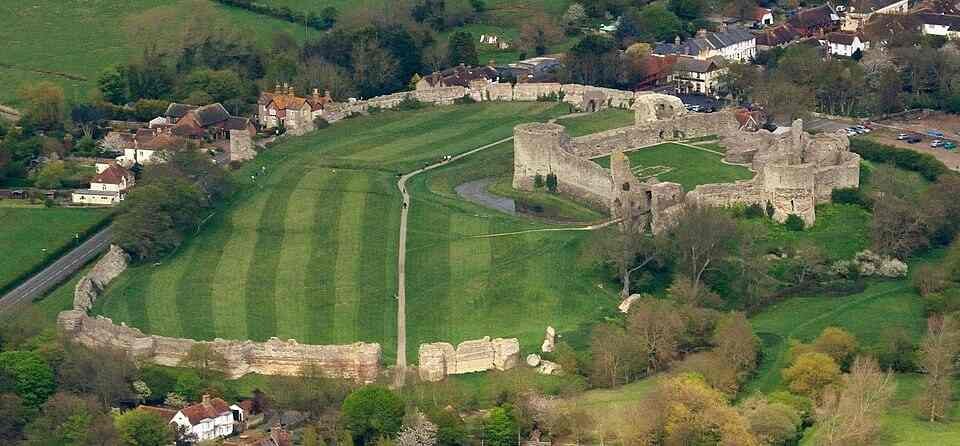
Pevensey Castle chronicles more graphically than any other fortress the story of Britain’s south coast defences, with a remarkable history stretching back over 16 centuries. Beginning in the 4th century as one of the last and strongest of the Roman ‘Saxon Shore’ forts, two-thirds of whose towered walls still stand, it is also famously the landing place of William the Conqueror’s army in 1066, making it one of the most historically significant sites in English history.
The strategic defensive importance of Pevensey Castle stems from its coastal position guarding one of southern England’s most vulnerable invasion points. The Romans built the fortress known as Anderitum around 290-340 AD as part of their Saxon Shore defensive system, designed to protect Roman Britain from seaborne raiders. The massive walls, up to 28 feet high and 12 feet thick, enclosed approximately 10 acres and featured projecting bastions that allowed defenders to provide covering fire along the walls.
The Roman fortification demonstrates sophisticated military engineering adapted to coastal defence requirements. The irregular oval plan followed natural topography while maximizing defensive strength, with walls constructed from local flint and stone bonded with Roman mortar. Archaeological evidence reveals the fort housed a substantial garrison equipped with artillery and naval vessels, making it a formidable obstacle to would-be invaders throughout the late Roman period.
William the Conqueror’s landing at Pevensey Bay on 28 September 1066 marked one of history’s most pivotal moments. Finding the Roman fort unmanned, William immediately built a temporary fortification within the ancient walls, cutting a ditch across the peninsula to isolate the ruins and repairing defences to shelter his invasion force. This decisive action provided the secure beachhead from which William launched his conquest of England, fundamentally altering British history.
The Norman castle construction within Roman walls created a unique fortress-within-a-fortress arrangement. Robert, Count of Mortain, William’s half-brother, received Pevensey and built the impressive stone keep and inner bailey walls in the southeast corner of the Roman fort. This medieval castle occupied roughly one-third of the Roman enclosure, creating concentric defences that combined Roman and Norman military engineering in a single integrated fortress.
Medieval development continued through successive centuries as Pevensey remained strategically important for coastal defence. The castle withstood multiple sieges including the 1088 rebellion of Odo of Bayeux against William II, and the 1264-5 siege during the Second Barons’ War when Simon de Montfort’s forces attacked the castle. These conflicts demonstrate Pevensey’s continuing military value and architectural strength throughout the medieval period.
The castle’s role in World War II added another remarkable chapter to its defensive history. In 1940, with invasion threatening, the ancient stronghold was pressed back into service with machine gun posts cleverly camouflaged into Roman and medieval walls. Observation posts, anti-aircraft positions, and a command centre transformed the 1,600-year-old fortress into a modern defensive position, demonstrating the enduring strategic value of its coastal location.
Modern visitor facilities include comprehensive exhibitions covering Roman construction, Norman conquest, medieval sieges, and World War II reactivation. The extensive grounds provide space to roam and explore, while interpretive displays bring 16 centuries of military history to life. Family activities and educational programs make Pevensey Castle an engaging destination for all ages.
An interesting historical fact involves Pevensey’s remarkable longevity as an active military installation. From its Roman construction around 290 AD to its World War II service in 1940, the fortress served defensive purposes for over 1,650 years – longer continuous military use than virtually any other British fortification, spanning from the late Roman Empire to the Battle of Britain.
Frequently Asked Questions About Pevensey Castle
What are Pevensey Castle opening hours?
January-March: Saturday-Sunday 10am-4pm. April-October: Daily 10am-5pm. November-early December: Daily 10am-4pm. Closed mid-December to end of December except for select days. Last admission 30 minutes before closing.
How much does Pevensey Castle cost?
English Heritage members enjoy free entry. Non-members pay standard admission with online booking until midnight before visit providing discounts. Adult tickets typically around £10, with children and concessions reduced rates. Family tickets available.
Why is Pevensey Castle important?
Pevensey Castle is where William the Conqueror landed in 1066 to begin the Norman Conquest of England. It also represents one of the best-preserved Roman Saxon Shore forts, with two-thirds of the original Roman walls still standing after 1,700 years.
Can you walk on Pevensey Castle walls?
Yes, visitors can walk sections of both the Roman walls and explore the medieval inner castle. The extensive grounds allow comprehensive exploration of this unique fortress-within-a-fortress, experiencing both Roman and Norman defensive architecture.
Is Pevensey Castle suitable for families?
Yes, it’s an excellent family destination with open grounds providing space to roam and explore. Exhibitions cover fascinating history from Romans to World War II, while educational activities engage children in understanding this remarkable 16-century story of coastal defense.
Where can I park at Pevensey Castle?
Free on-street parking available in Westham and Pevensey village. A pay and display public car park with approximately 50 spaces is located about 300 meters from the castle entrance (not managed by English Heritage).
What makes Pevensey Castle unique?
The combination of Roman Saxon Shore fort with Norman castle creates a unique fortress-within-a-fortress. Its role as William the Conqueror’s 1066 landing site and 1940s World War II reactivation make it unparalleled in British defensive history.
Nearby Defence Heritage Sites of Interest
Site Name Type Distance (miles) Eastbourne Redoubt Napoleonic fortification 5 Hastings Castle Medieval coastal castle ruins 6 Lewes Castle Norman/medieval hilltop castle 9 Rye Castle Museum Medieval town castle / maritime defences 10 Battle Abbey Fortified abbey site / Norman battlefield 12 Newhaven Fort 19th/20th-century coastal fortification 18 Kent Battle of Britain Museum Aviation / military museum 28 Bodiam Castle 14th-century moated defensive castle 20 Camber Castle (remains) Tudor artillery fort (ruined) 21 Winchelsea fortifications Medieval town defences and earthworks 22 Rye Harbour defences Coastal wartime defences and pillboxes 24
image credit: Lieven Smitsderivative
Share
See on the Map
Contact Info
- 01323 762604
- pevensey.castle@english-heritage.org.uk
- www.english-heritage.org.uk/visit/places/pevensey-castle
- Castle Road, Pevensey, East Sussex BN24 5LE, England