
Eastbourne Redoubt Fortress
Features
Description
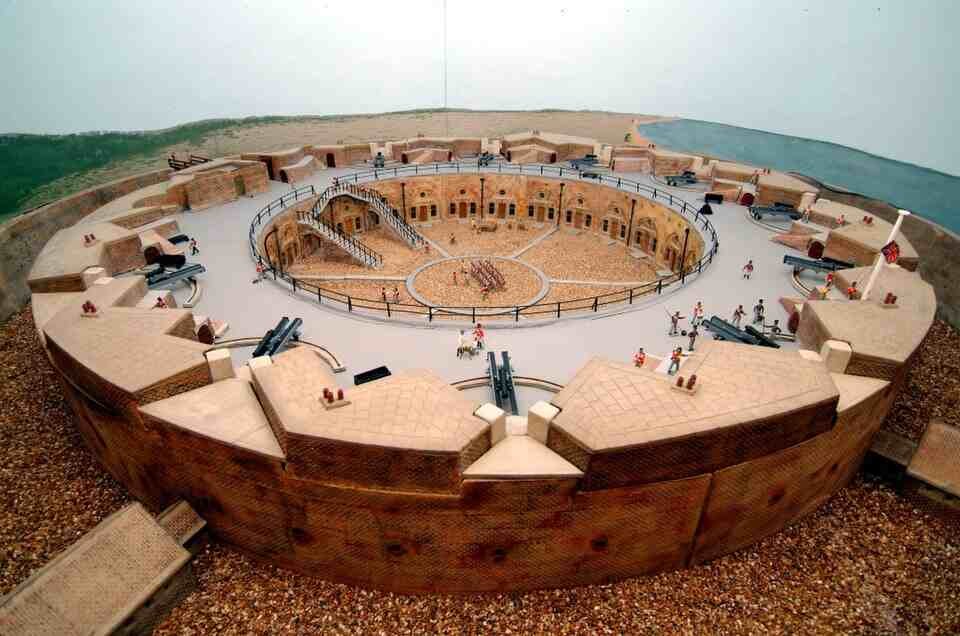
Eastbourne Redoubt Fortress is one of the most impressive Napoleonic fortifications on England’s south coast. Built between 1805 and 1810 as part of Britain’s defensive preparations against Napoleon’s threatened invasion, this circular coastal fortress represents a remarkable piece of military engineering and Georgian architecture. Located on Royal Parade in Eastbourne, East Sussex, the Redoubt formed part of an ambitious chain of coastal defences that included 74 Martello towers stretching from Folkestone to Seaford.
The fortress measures an impressive 224 feet (68 metres) in diameter and was constructed using five million bricks, many transported by barge from London along the east coast. The contract for this monumental project was awarded to William Hobson, a successful Quaker builder from Markfield House in South Tottenham.
Construction began on 16 April 1805, though completion was delayed until 1810 due to the enormous scale of the undertaking. The building stands on a foundation of compacted chalk laid directly onto natural shingle, with cavities filled with shingle for additional stability.
The Redoubt’s unique circular design comprises 24 vaulted chambers called casemates arranged in a ring around a central parade ground. These bomb-proof rooms were originally intended to accommodate up to 350 soldiers, though it’s believed no more than 200 were ever stationed there simultaneously.
The upper level features a gun platform with granite-faced embrasures designed for eleven guns, though only ten were typically mounted. The fortress is surrounded by a dry moat 25 feet wide and 30 feet deep, with five caponiers (covered galleries) allowing defenders to fire at attackers who reached the moat.
Interestingly, the Redoubt’s guns were only fired in anger once throughout its entire military history. In 1812, two shots were fired at a passing French warship but both missed their target. By the time the fortress was fully armed and operational, Napoleon’s defeat at Waterloo in 1815 had eliminated the invasion threat.
During the Victorian era, the fort’s role evolved from active defence to training barracks, with armament progressively upgraded including replacement of the original guns with 68-pounder smoothbore cannons in 1853.
During World War I, the Redoubt served as military police headquarters and a temporary prison. Following the war, Eastbourne Borough Council purchased it for just £150 with ambitious plans to transform it into a leisure venue. A bandstand was constructed in the grounds in 1934, though most leisure plans remained unrealised.
During World War II, the army requisitioned the building for storage, and in 1944 anti-aircraft guns were mounted on the gun platforms to counter German V-1 flying bombs passing overhead.
The fortress later housed regimental museums including collections from the Royal Sussex Regiment and the Queen’s Royal Irish Hussars, featuring fascinating artefacts such as a Russian bugle used during the Charge of the Light Brigade.
The site has also hosted various attractions over the decades, including Benjamin White’s remarkable Model Village from 1957, which featured intricate miniature buildings with real glass windows and individual roof tiles.
Today, Eastbourne Redoubt remains one of only three surviving grand redoubts from the Napoleonic era and represents a scheduled monument protected by Historic England. The fortress offers spectacular views across Pevensey Bay towards Hastings and provides visitors with an authentic glimpse into early 19th-century military life. The site includes interactive exhibits, guided tours, and hosts special events including films, stargazing nights, and historical reenactments.
Visitor Reviews from the Web
Visitors consistently praise the Redoubt’s impressive architecture and historical significance. Many describe the circular structure with its deep dry moat and drawbridge as impressive from the outside and appreciate the massive scale of this Napoleonic fortress.
Families particularly enjoy the interactive displays and hands-on activities for children, with one reviewer noting their children loved looking at the cannons up the top and appreciated the fun activity room.
The guided tours receive excellent feedback, with visitors describing guides as very informative and providing plenty of insight into the workings of this fortress and the soldiers who would have been stationed here.
One reviewer called it one of the best military museums I have ever visited, praising the extensive collection of uniforms dating from the Crimean War to present day and the interesting origins of words like cardigan and balaclava.
The free access to the parade ground and gun platform is frequently mentioned as a positive feature, allowing visitors to explore the exterior and enjoy fantastic views all round without admission charges. The onsite Pavilion Cafe receives compliments for serving very good cafe food with homemade cakes and reasonable prices.
Some visitors note the fortress appears grim and gloomy but find this adds to the authentic historical atmosphere.
Recent reviewers mention the site has been closed for essential maintenance work, though the exterior remains accessible and worth visiting for its remarkable architecture and coastal gardens.
Special events like Halloween ghost tours and VE Day celebrations are highlighted as particularly engaging experiences that bring the fortress’s history to life.
Frequently Asked Questions
What is Eastbourne Redoubt Fortress and when was it built?
Eastbourne Redoubt Fortress is a circular coastal defence fort built between 1805 and 1810 as part of British preparations against Napoleon’s planned invasion during the Napoleonic Wars. It’s one of only three surviving grand redoubts from this era, designed to act as both a fortress and a barracks/supply depot for the chain of 74 Martello towers along the southeast coast.
How big is the Redoubt Fortress?
The fortress measures 224 feet (68 metres) in diameter and consists of 24 vaulted chambers arranged in a ring around a central parade ground. It was built using five million bricks, with over 50,000 bricks used in a single course. The structure is surrounded by a dry moat 25 feet wide and 30 feet deep.
What can visitors see at the Redoubt today?
Visitors can explore the gun platform and parade ground for free, with views across Pevensey Bay. The interior features regimental museums displaying military collections from the Royal Sussex Regiment and Queen’s Royal Irish Hussars, including uniforms, weapons, and historical artefacts. The site hosts various events including guided tours, films, and special themed nights.
Was the Redoubt ever used in combat?
Despite its formidable defences, the Redoubt’s guns were only fired in anger once. In 1812, two shots were fired at a passing French warship but both missed. By the time the fortress was fully operational, Napoleon’s defeat at Waterloo in 1815 had eliminated the invasion threat, and it served primarily as a training barracks rather than an active combat post.
Who built the Eastbourne Redoubt?
The construction contract was awarded to William Hobson, a successful Quaker builder from Markfield House in South Tottenham. Work began on 16 April 1805 and continued until 1810. Hobson was also commissioned to build Martello towers along the south and east coasts and was involved in constructing the London Docklands and Newgate prison.
What happened to the Redoubt during the World Wars?
During World War I, it served as military police headquarters and a temporary prison. After being purchased by Eastbourne Borough Council for £150, plans were made to convert it into a leisure venue, though only a bandstand was built in 1934. During World War II, the army requisitioned it for storage and mounted anti-aircraft guns on the platforms to counter V-1 flying bombs in 1944.
Why is it called a redoubt?
The term redoubt refers to a type of fortification, typically a small, enclosed defensive work. These three 11-gun circular forts came to be known as circular forts or grand redoubts to distinguish them from the smaller single-gun Martello towers. They were designed to provide 360-degree defence while serving as command centres and supply depots for the Martello chain.
Is the Redoubt Fortress wheelchair accessible?
Accessibility can be challenging as the historic fortress features steep double staircases and multiple levels. Some reviews mention needing to carry strollers down stairs. However, the Pavilion has rear door access for disabled visitors, and the parade ground and upper gun platform may be more accessible. It’s recommended to contact the site directly for current accessibility information.
What are the opening times and admission prices?
Historically, the Redoubt opened April to mid-November, typically 10am-5pm, closed Mondays. Access to the gun platform and parade ground is free, with admission charges for the interior museums. However, the site has been closed for essential maintenance work. Visitors should check the official website or contact Eastbourne Borough Council for current opening status and admission prices.
Can you host events at the Redoubt?
The Redoubt has hosted various events including films, lectures, historical tours, stargazing nights, Halloween ghost tours, and VE Day celebrations. The venue features a Pavilion Cafe and has been used for exhibitions. Eastbourne Borough Council is currently considering future uses for the fortress including potential artisan units, farmers’ markets, and live music events as part of regeneration plans.
Nearby Defence Heritage Sites of Interest
| Site Name | Type | Distance (miles) |
|---|---|---|
| Pevensey Castle | Roman/Saxon shore fort and medieval castle | 5 |
| Newhaven Fort | 19th/20th-century coastal fortification | 10 |
| Michelham Priory | Moated medieval priory with WWII exhibits | 11 |
| Herstmonceux Castle | 15th-century moated brick castle | 13 |
| Battle Abbey | Fortified abbey and 1066 battlefield site | 15 |
| Shoreham Fort | Victorian coastal defence fort | 19 |
| Lewes Castle | Norman motte-and-bailey castle | 20 |
| Kent Battle of Britain Museum | Aviation and military museum | 27 |
| Camber Castle | Tudor artillery fort (ruined) | 28 |
| Rye Castle Museum (Ypres Tower) | Medieval town castle and maritime defences | 29 |
Image credit: Ksimisk
Share
See on the Map
Contact Info
- 01323410300
- www.lewes-eastbourne.gov.uk/article/4658/New-guided-talks-launched-at-Redoubt-Fortress
- Royal Parade, Eastbourne BN22 7AQ