
St Mawes Castle
Features
Description
St Mawes Castle stands as the most perfectly preserved example of Henry VIII’s revolutionary coastal defence program, representing the pinnacle of Tudor military architecture and engineering innovation. St Mawes Castle is Henry VIII’s best-preserved artillery fort, demonstrating how Renaissance military science transformed British coastal fortifications during the 16th-century artillery revolution.
Pendennis Castle and St Mawes Castle are two of Henry VIII’s coastal defence forts, known as ‘device forts’, built on the shores of the Fal estuary between 1539 and 1547. The strategic pairing of these fortresses created an impregnable defensive system protecting one of Britain’s most important natural harbors and naval bases.
The defensive significance of St Mawes Castle lies in its precision-engineered fields of fire across the Fal estuary approaches. Working in concert with Pendennis Castle on the opposite shore, St Mawes created crossfire zones that no enemy vessel could navigate safely. This revolutionary approach to harbor defence influenced fortress design throughout the British Empire.
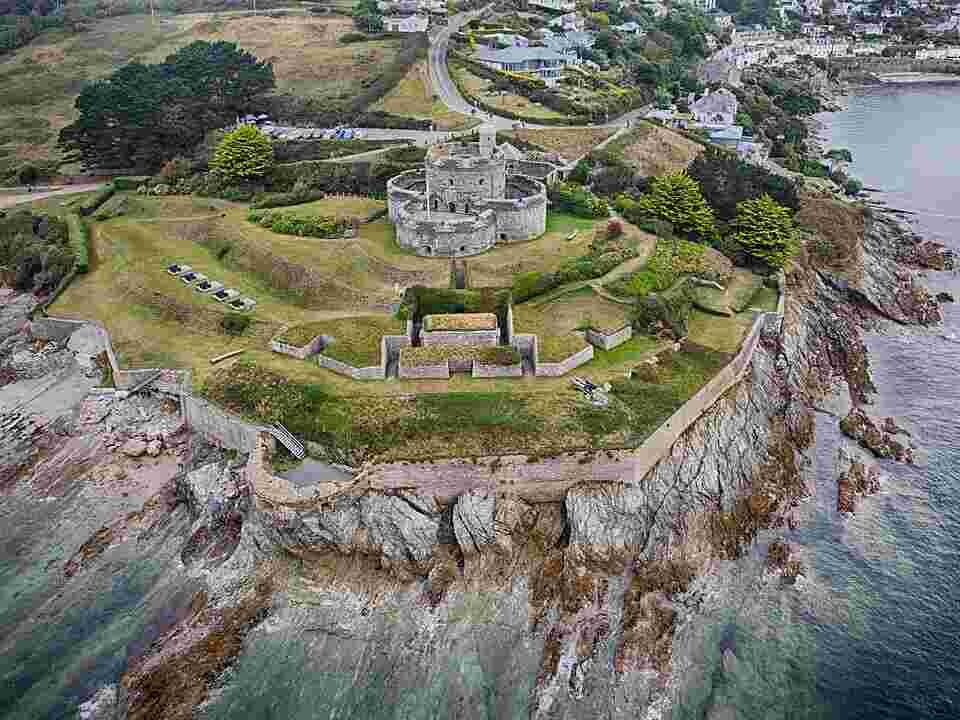
Construction began in 1540 under the direction of Henry VIII’s military engineers, incorporating the latest continental artillery fortress design principles. The castle’s distinctive cloverleaf plan, with its central keep surrounded by three curved bastions, represents mathematical precision applied to military architecture. Each element was calculated to maximize defensive firepower while minimizing structural vulnerability.
The castle’s architectural perfection demonstrates Renaissance military engineering at its finest. The curved walls and angled surfaces were specifically designed to deflect cannon balls, while gun ports were precisely positioned to create overlapping fields of fire. The absence of vertical walls eliminated vulnerable targets for enemy artillery.
St Mawes Castle’s remarkably complete survival provides unique insights into Tudor military architecture and daily garrison life. Unlike many coastal forts that were extensively modified for later conflicts, St Mawes retains its original 16th-century character almost intact, making it invaluable for understanding Henry VIII’s defensive innovations.
The castle’s interior arrangements reveal sophisticated planning for artillery warfare. Gun chambers, ammunition stores, and living quarters were arranged to maintain operational efficiency during extended engagements. The central keep housed the garrison commander and provided final refuge if outer defenses were breached.
Decorative elements at St Mawes Castle demonstrate that even purely military structures could embody Renaissance artistic ideals. Stone carvings, heraldic symbols, and architectural proportions reflect contemporary aesthetic principles, proving that functionality and beauty could coexist in fortress design.
The castle served continuously as a military installation through both World Wars, adapting to changing defensive requirements while preserving its historic character. Modern military installations were discretely integrated with Tudor structures, demonstrating how historic fortifications could serve contemporary military needs.
The surrounding landscape of St Mawes village and harbour illustrates how coastal fortifications influenced settlement patterns and economic development. The castle’s protection encouraged maritime trade and shipbuilding, making St Mawes a prosperous port throughout the age of sail.
An interesting historical fact involves St Mawes Castle’s surrender during the English Civil War. Unlike Pendennis Castle’s heroic five-month siege, St Mawes surrendered to Parliamentary forces without significant resistance, preserving the structure’s remarkable completeness that visitors enjoy today.
Frequently Asked Questions About St Mawes Castle
What makes St Mawes Castle special?
St Mawes Castle is Henry VIII’s best-preserved artillery fort, representing the pinnacle of Tudor military architecture. Its complete survival and innovative design make it unique among British coastal fortifications.
Can you visit St Mawes Castle year-round?
St Mawes Castle typically operates April to October with seasonal opening hours. Winter access may be limited, so check the English Heritage website for current opening times and seasonal variations before visiting.
How long does a St Mawes Castle visit take?
Most visitors spend 1-2 hours exploring the compact but fascinating castle. The site’s intimate scale allows thorough exploration of all chambers and defensive positions within a relatively short visit.
Is St Mawes Castle suitable for children?
Yes, children enjoy exploring the gun chambers, climbing the battlements, and learning about Tudor soldiers’ lives. The castle’s manageable size and excellent preservation make it ideal for young visitors interested in history and military architecture.
What can you see from St Mawes Castle?
The castle provides spectacular views across the Fal estuary to Pendennis Castle, Falmouth harbour, and the surrounding Cornish coastline. These panoramic vistas demonstrate the strategic importance of the fortress location.
Does St Mawes Castle have parking?
Limited parking is available in St Mawes village, though spaces can be scarce during summer months. The castle is within walking distance of the village centre and harbour, making it accessible for visitors exploring the area.
Are there facilities at St Mawes Castle?
Basic visitor facilities are available, though the compact site has limited amenities compared to larger English Heritage properties. St Mawes village nearby offers cafes, shops, and restaurants for visitor refreshments.
Can you combine St Mawes with Pendennis Castle
Yes, many visitors explore both castles to understand the complete defensive system. Ferry services operate between St Mawes and Falmouth, making it possible to visit both fortresses in a single day.
Nearby Defence Heritage Sites of Interest
| Site Name | Type | Distance (miles) |
|---|---|---|
| Pendennis Castle | 16th-century coastal artillery fortification | 1.21 |
| St Anthony Head Battery | 19th-century coastal artillery battery | 3 |
| Polruan Old Battery | 19th-century coastal artillery battery | 4 |
| St Catherine’s Castle | 16th-century coastal artillery fortification | 20.48 |
| Restormel Castle | 13th-century shell-keep castle ruin | 20 |
| Tintagel Castle | Medieval coastal castle ruins | 28 |
Image credit: Kernow Skies
Share
See on the Map
Contact Info
- 01326 270526
- www.english-heritage.org.uk/visit/places/st-mawes-castle
- Castle Drive, St Mawes, Truro TR2 5AA, Cornwall