
Richborough Roman Fort
Features
Description
Richborough Roman Fort stands as perhaps the most symbolically important Roman site in Britain, marking both the beginning and near the end of Roman rule spanning almost 400 years from AD 43 to approximately 410.
Known in Roman times as Rutupiae, this extraordinary site witnessed the Claudian invasion force of 40,000 men landing on these Kent shores to establish a bridgehead that would transform Britain into a Roman province. The impressive stone walls rising several metres high preserve the Saxon Shore fortress, while the recreated timber Roman gateway provides panoramic views across the site and surrounding countryside, bringing this ancient gateway to Britannia dramatically back to life.
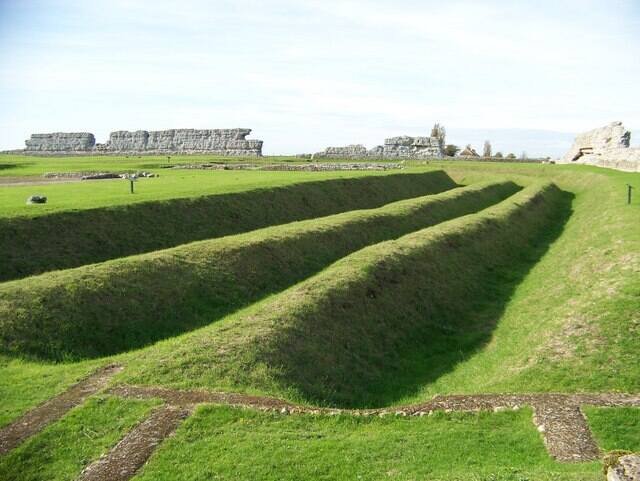
The strategic defensive importance of Richborough stemmed from its commanding position at the southern end of the Wantsum Channel, the waterway that once separated the Isle of Thanet from mainland Kent, creating a natural harbour ideal for Roman military and commercial operations. The site guarded this vital maritime route while serving as the main port of entry for imports into Britain and the starting point for Watling Street, the great Roman road connecting this coastal gateway directly to London and northwestern Britain. Twin V-shaped invasion ditches extending over 650 metres protected the initial beachhead and supply depot.
The fort’s architectural evolution reflects changing military requirements across four centuries. Early earthwork fortifications secured the invasion bridgehead before civilian development transformed Rutupiae into a prosperous port town.
The construction around AD 85 of a massive quadrifrons triumphal arch, almost 25 metres high and clad in Italian granite, celebrated the conquest of Britain. This monumental gateway, straddling Watling Street between port and province, signified formal entry into Britannia. Only foundations remain today as the Romans themselves demolished it around 277 to provide building materials for the Saxon Shore fort constructed when coastal defences became urgent priorities.
The Saxon Shore fortress, built between 277 and 285 to defend against Saxon raiders, represents late Roman military architecture at its most impressive. The stone walls, still standing to considerable heights, enclosed approximately 6 acres with massive defensive earthworks creating concentric protective layers. These formidable fortifications demonstrate Roman engineering prowess while illustrating the empire’s determination to maintain Britain despite increasing external threats and internal challenges that would eventually overwhelm Roman authority.
The revamped museum features finds from recent excavations tracing Richborough’s 360-year story through artifacts revealing daily life, commerce, military operations, and religious practices. Displays include pottery, coins, jewelry, tools, and architectural fragments recovered from systematic archaeological investigations.
The audio tour, included with admission, guides visitors around the site with expert historical interpretation bringing ruins alive through vivid descriptions of Richborough’s transformation from invasion beachhead through prosperous port to fortress defending a declining empire.
The nearby amphitheatre, visible as earthwork remains approximately five minutes’ walk from the main fort, demonstrates the town’s prosperity and Roman cultural influence. Though less visually dramatic than the stone fort, the amphitheatre’s presence confirms Rutupiae developed full range of Roman urban amenities including entertainment facilities where gladiatorial contests and public spectacles entertained residents and visitors arriving through this gateway to Roman Britain.
An interesting historical fact involves Richborough’s fame throughout the Roman Empire for exceptional oyster quality, mentioned by the satirist Juvenal as comparable to Italy’s prestigious Lucrine Lake oysters. The phrase ‘Rutupine shore’ became literary shorthand for Britain itself in Latin writing, demonstrating how this strategic port symbolised the entire distant northern province in Roman consciousness.
Visitor Reviews from the Web
Positive reviews consistently praise Richborough’s immense historical significance as the Roman invasion landing site and gateway to Britain. Visitors appreciate the knowledgeable, passionate staff and volunteers whose enthusiasm brings history alive.
The excellent audio guide receives universal acclaim for making the ruins comprehensible and engaging. Recent improvements including the recreated Roman gateway, revamped museum, and enhanced interpretation earn consistent praise. Many reviewers describe it as a hidden gem offering peaceful exploration without crowds.
The substantial wall remains impress with their height and preservation. English Heritage members particularly value free entry. Dog-friendly grounds appeal to pet owners. Families with children interested in Romans find it educational and accessible. The peaceful marshland setting and panoramic views enhance the atmospheric experience.
Negative aspects mentioned include the site requiring considerable imagination to visualize former glory, which may disappoint those expecting more substantial visible remains. Some visitors find the amphitheatre disappointing and difficult to locate without clear signposting.
The narrow winding access road makes nervous drivers uncomfortable. Limited on-site amenities mean only a coffee machine and ice cream available rather than proper café facilities.
The exposed coastal location can be uncomfortable during wind and rain.
Some reviewers consider admission prices steep for the size of ruins, though English Heritage members get free entry. Young children without historical interest may find it boring. A few visitors mention toilet facilities needing improvement, described as basic eco-toilets.
Frequently Asked Questions About Richborough Roman Fort
What are Richborough Roman Fort opening hours?
Open daily 10am-5pm April to October (last entry 4:30pm). November to March weekends only 10am-4pm. Closed Christmas period. Opening times may vary seasonally so check English Heritage website before visiting for current hours.
How much does Richborough Roman Fort cost?
English Heritage members enjoy free entry. Non-members pay standard admission with adult tickets typically £8-10, children reduced rates, family tickets available. Online booking provides discounts. The site offers excellent value considering historical significance and recent improvements.
Can you climb the Roman gateway at Richborough?
Yes, visitors can climb the meticulously recreated timber Roman gateway built on its exact original location for panoramic views over the entire fort site and surrounding Kent countryside, providing perspective on the site’s layout and strategic positioning.
Is Richborough Roman Fort suitable for families?
Yes, excellent for families with children interested in Roman history. The family trail, audio guide, and impressive wall remains engage young visitors. However, those without historical interest may find it less engaging. The open grassy site allows children space to explore safely.
What is the Watling Street connection to Richborough?
Richborough was the starting point for Watling Street, the major Roman road connecting this coastal gateway directly to London and northwestern Britain. Crossing the wooden bridge over the Saxon Shore ditches at the west gate places visitors on the actual Watling Street route.
Where can I park at Richborough Roman Fort?
Large free car park available on-site immediately adjacent to the visitor centre. Ample parking for cars and coaches. The fort is accessed via narrow country lanes requiring careful driving, particularly when meeting oncoming vehicles.
How long should I spend at Richborough Roman Fort?
Plan 2-3 hours for comprehensive exploration including museum, fort ruins, audio tour, and amphitheatre walk. The peaceful atmosphere and extensive site reward leisurely investigation. History enthusiasts often spend longer absorbing the significance of this gateway to Roman Britain.
Nearby Defence Heritage Sites of Interest
| Site Name | Type | Distance (miles) |
|---|---|---|
| Deal Castle | Tudor concentric artillery fort | 6 |
| Sandown Castle (remains) | Tudor artillery fort (ruined) | 6 |
| Walmer Castle | Tudor coastal artillery fort | 7 |
| RAF Manston History Museum | Aviation museum with Cold War and WWII exhibits | 8 |
| Spitfire & Hurricane Memorial Museum | WWII aviation museum | 8 |
| Ramsgate Tunnels | WWII civilian and military underground shelter | 10 |
| Dover Castle | Medieval fortress with WWII tunnels and Cold War command centre | 13 |
| RAF Swingate (remains) | WWII radar and Cold War communications site | 14 |
| Fort Burgoyne | Victorian fortification with Napoleonic origins | 15 |
| The Powell-Cotton Museum | Includes military ethnography and colonial history | 18 |
Image credit: Elliott Simpson
Share
See on the Map
Contact Info
- 01304 612013
- www.english-heritage.org.uk/visit/places/richborough-roman-fort-and-amphitheatre
- Off Richborough Road, Sandwich, Kent CT13 9JW, England