
Winchelsea Town Defences, East Sussex
Features
Description
Winchelsea Town Defences represent one of England’s finest examples of medieval town planning and fortification, where three magnificent stone gateways survive from Edward I’s 1280s planned town built to replace Old Winchelsea swept away by catastrophic storms in 1287.
The Strand Gate, Pipewell (Ferry) Gate, and New Gate demonstrate sophisticated defensive architecture protecting what became one of the realm’s primary ports during the 14th century, when Winchelsea prospered as a Cinque Port handling equivalent of four million wine bottles annually from Gascony while maintaining naval facilities for the crown.
The strategic defensive importance of Winchelsea stemmed from its commanding hilltop position overlooking Romney Marsh and controlling the confluence of Rivers Brede, Rother, and Tillingham at the sheltered Camber anchorage.
Edward I’s planned town, laid out 1281 on a rectangular grid pattern by Henry le Waleys and Thomas Alard, created a fortified settlement safeguarding vital cross-Channel trade routes and naval operations. The town walls, granted murage (taxation rights for defensive construction) in 1295, protected against French raids during the Hundred Years War when Winchelsea’s prosperity made it a tempting target.
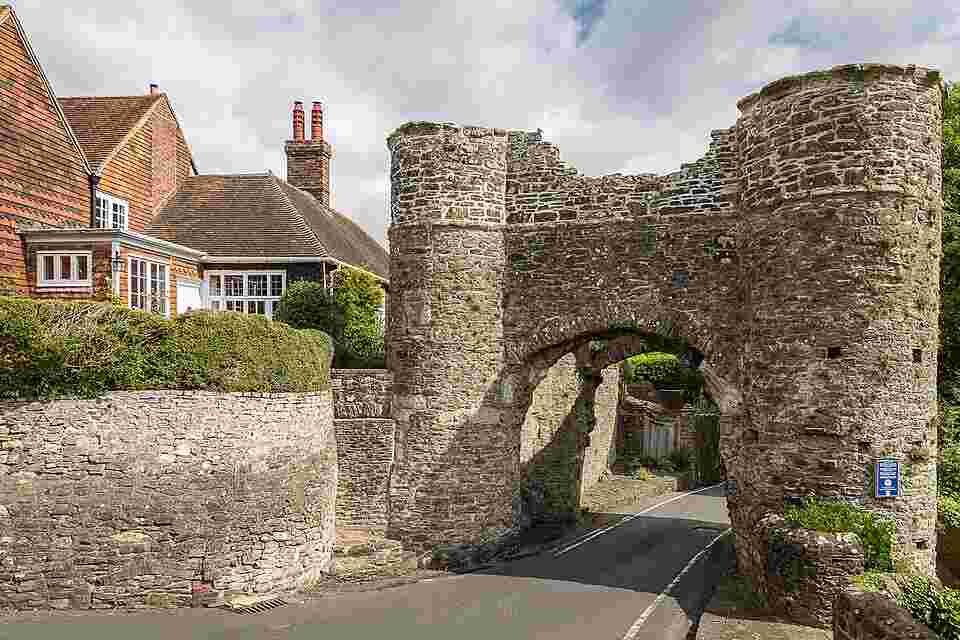
The three surviving gates demonstrate evolving defensive requirements across centuries. Strand Gate, the main entrance from the port area below, still carries traffic into the hilltop town, its solid stone construction testifying to medieval mason craftsmanship. The gate originally featured heavy wooden doors and a portcullis, creating multiple barriers against attackers approaching from the vulnerable seaward approaches.
The town ditch running beside the gates acted as both water channel and secondary defensive line, requiring attackers to cross exposed ground under fire from defenders above.
New Gate, despite its name dating to 13th-century construction, stands isolated over half a mile from the current town centre, dramatically illustrating New Winchelsea’s ambitious original scale before French raids and port silting caused abandonment of southern quarters. New Gate straddles Wickham Rock Lane on the town’s southwest, with the defensive ditch still visible running alongside. Tragically, New Gate failed its defensive purpose in 1380 when French raiders gained entry through this gateway, tradition suggesting treachery from within enabled the breach. The devastating raid sacked the town and damaged St Thomas Church, demonstrating how human factors could overcome even sophisticated fortifications.
Pipewell Gate, standing at the junction of North Street and Ferry Hill, represents medieval reconstruction following French destruction. The original ferry gate fell to raiders in 1380, with Mayor John Helde overseeing construction of its replacement in 1404. This youngest surviving gateway demonstrates how Winchelsea adapted defenses following bitter experience, incorporating lessons from earlier vulnerabilities. The gateway’s name derives from the pipe well providing water access near the ferry crossing to Romney Marsh below.
The devastating French raid of 1380 demonstrated the consequences when port rivalries and international conflict combined. French forces sacked prosperous Winchelsea, destroying buildings and killing inhabitants, a trauma that accelerated the town’s decline alongside progressive harbour silting that ultimately strangled maritime trade.
The abandoned southern suburbs, visible as turf-covered foundations in fields south of New Gate, provide poignant testimony to Winchelsea’s diminished fortunes after this calamity and environmental changes ended its maritime prosperity.
Medieval wine cellars, with 33 accessible via tours, provide underground evidence of Winchelsea’s commercial importance. These vaulted stone undercrofts stored the vast wine imports from Gascony that enriched 14th-century merchants and generated royal customs revenues. The cellars’ preservation demonstrates how underground structures survive better than surface buildings, offering insights into medieval commercial architecture impossible at sites where cellars were backfilled or destroyed.
Winchelsea Court Hall Museum, occupying a 14th-century building that served as town hall from 1557, displays civic regalia, pottery, photographs, models, and seals illustrating the town’s remarkable history. The museum’s highlight includes a mayoral list complete to 1430 and partially to 1295 when mayors replaced royal bailiffs, creating one of Britain’s most impressive continuous civic records. The museum, staffed by knowledgeable volunteers spring to autumn, provides essential historical context for understanding the gates and defensive remains.
An interesting historical fact involves the lost fourth gate, mentioned in records but now vanished completely. Antiquarians suggest Rye Harbor improvements consumed much Winchelsea stone as townspeople robbed abandoned buildings to maintain Rye’s declining harbour. This pragmatic stone recycling explains the otherwise puzzling absence of substantial wall remains despite documentary evidence of extensive 13th-century fortifications. The thin walls (40-50cm) suggested by toothing patterns in surviving gates would have created impressive appearance particularly from seaward despite relatively light construction.
Visitor Reviews from the Web
Positive reviews consistently describe Winchelsea as a hidden gem offering peaceful exploration of well-preserved medieval town planning. Visitors appreciate the three magnificent gates with their informative blue plaques providing historical defensive context.
Many reviewers enjoy walking the grid-pattern streets imagining the prosperous medieval port town. St Thomas Church receives universal acclaim for Douglas Strachan’s extraordinary stained glass windows.
The Court Hall Museum earns praise for knowledgeable volunteers and fascinating civic regalia displays. Visitors value Spike Milligan’s grave as unexpected celebrity connection. The atmospheric hilltop setting with spectacular Romney Marsh and sea views consistently features in positive reviews. Many describe Winchelsea as perfect for history enthusiasts seeking authentic medieval towns without tourist crowds.
Negative aspects mentioned occasionally include disappointment at limited surviving wall sections, with visitors expecting more substantial visible fortifications given the gates’ impressive preservation.
Some reviewers note the Court Hall Museum’s limited opening hours (spring to autumn, volunteer-dependent) can frustrate those visiting outside operating periods.
A few visitors find the town too quiet with limited amenities – essentially one pub and one shop – though most acknowledge this tranquility constitutes part of Winchelsea’s charm.
The medieval cellars requiring booked tours disappoint those expecting spontaneous access.
Some reviews mention lack of comprehensive interpretation beyond gate plaques, requiring visitors to conduct prior research for full historical understanding.
Parking can be challenging during busy periods with limited spaces and no large car park.
Frequently Asked Questions About Winchelsea Town Defences
What are Winchelsea town gates opening hours?
The gates are accessible year-round as they span public roads and pathways. Strand Gate carries vehicle traffic, while New Gate and Pipewell Gate can be viewed and approached freely during daylight hours. Informative blue plaques at each gate provide historical details. FREE access at all times.
How much does it cost to visit Winchelsea defences?
FREE access to all three medieval gates and town streets year-round. The Court Hall Museum welcomes donations supporting conservation. Medieval cellar tours (33 accessible undercrofts) have separate booking and pricing through tour operators – check winchelsea.com for current details.
Can you walk on Winchelsea town walls?
Very limited wall sections survive, with one reportedly existing beside a path to a spring where it revets the hillside. The town ditch remains visible beside New Gate. Most fortifications were demolished over centuries with stone robbed for other uses, particularly Rye Harbour improvements.
What are the three medieval gates?
Strand Gate (main entrance from port area, still carrying traffic), Pipewell or Ferry Gate (rebuilt 1404 after French destruction in 1380, at junction North Street/Ferry Hill), and New Gate (13th century, isolated half-mile from town center illustrating original ambitious scale).
Is Winchelsea Court Hall Museum open?
The museum operates spring to autumn, staffed by volunteers. Opening hours vary seasonally so check www.winchelsea.com or call ahead. The museum occupies the first floor of the 14th-century Court Hall on High Street, displaying civic regalia, local pottery, models, photographs, and the remarkable mayoral list dating to 1295.
Where can I park in Winchelsea?
Limited free parking available on streets around the town centre. No large dedicated visitor car park exists. The A259 main road passes through Winchelsea with some roadside parking possible. Visitors should arrive early during popular periods or visit outside peak times for easier parking.
How long should I spend in Winchelsea?
Plan 1-2 hours for walking the town, viewing gates, visiting St Thomas Church, and exploring streets. Add 1-2 hours if Court Hall Museum is open or if taking medieval cellar tours. The compact town center allows comprehensive exploration in relatively short time, though the atmospheric setting rewards leisurely investigation.
Nearby Defence Heritage Sites of Interest
| Site Name | Type | Distance (miles) |
|---|---|---|
| Rye Castle Museum (Ypres Tower) | Medieval town castle and maritime defences | 2 |
| Camber Castle | Tudor artillery fort (ruined) | 2 |
| Rye Harbour Wartime Defences | WWII coastal pillboxes and anti-invasion sites | 3 |
| Romney Marsh Wartime Collection | WWII military museum and home front exhibits | 10 |
| Brenzett Aeronautical Museum | WWII aviation museum and dispersal hut | 11 |
| Dymchurch Redoubt | Napoleonic coastal fortification | 13 |
| Pevensey Castle | Roman/Saxon shore fort and medieval castle | 22 |
| Kent Battle of Britain Museum | Aviation and military museum | 26 |
| Battle Abbey | Fortified abbey and 1066 battlefield site | 27 |
| Newhaven Fort | 19th/20th-century coastal fortification | 30 |
Image credit: Adam Kumiszcza
Share
See on the Map
Contact Info
- winchelsea.tc@btinternet.com
- www.winchelsea.com
- High Street, Winchelsea, East Sussex TN36 4EA, England