
Launceston Castle
Features
Description
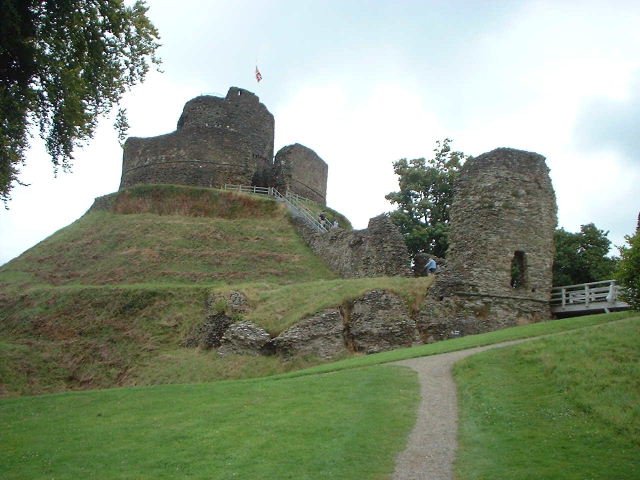
Launceston Castle stands as Cornwall’s premier Norman fortress, commanding the ancient crossing point into the Duchy from its elevated position on Castle Green. This remarkable medieval stronghold, originally known as Dunheved, represents nearly 1,000 years of defensive architecture and serves as the gateway to understanding Cornwall’s turbulent medieval history.
The strategic importance of Launceston Castle in medieval defence cannot be overstated. Positioned to control the primary route between Cornwall and Devon, the castle guarded the vital river crossing that determined access to the entire duchy. This chokepoint location made it essential for Norman control over Cornwall and subsequent English authority throughout the medieval period.
The castle’s unique architectural design features an unusual circular shell keep surrounding a 13th-century round tower, creating a distinctive double-defence system. The focus of the castle is an unusual keep consisting of a 13th-century round tower, inside an earlier circular shell-keep. This innovative approach demonstrates how Norman builders adapted continental fortress design to Cornish topography and defensive requirements.
Construction began shortly after the Norman Conquest, with Robert, Count of Mortain, establishing the original motte and bailey structure around 1070. The elevated natural mound provided commanding views across the surrounding countryside while the River Kensey offered additional natural protection. Archaeological evidence suggests earlier fortifications may have occupied this strategic site.
The castle served as the administrative center for Cornwall’s largest medieval honour, controlling vast estates and wielding significant political power. As the seat of the Earl of Cornwall, Launceston Castle hosted courts, collected revenues, and coordinated military activities throughout the duchy. This administrative role was as important as its defensive function.
Military architecture at Launceston demonstrates the evolution of castle design from Norman motte-and-bailey to sophisticated stone fortifications. The surviving gatehouse, with its twin towers and murder holes, exemplifies 13th-century defensive sophistication. There is a staircase offering access to the top of the tower, offering breath taking views of the historic town and countryside.
The castle’s role during various medieval conflicts illustrates its continued military importance. During the English Civil War, Parliamentary forces eventually dismantled much of the structure to prevent Royalist use. Towards the end of the civil war it was stripped for its building materials and rendered largely uninhabitable.
Later history saw the castle transformed into Cornwall’s county gaol, earning the notorious nickname ‘Castle Terrible’ due to harsh conditions. The castle eventually became the county gaol for Cornwall, but was heavily criticised for its poor facilities and treatment of inmates, earning it the nickname Castle Terrible. This period highlights how medieval fortifications adapted to serve different social functions.
An interesting historical fact involves the castle’s connection to Cornish tin mining. As administrative centre for the largest medieval honour in Cornwall, Launceston Castle controlled significant tin mining rights, making it crucial to Cornwall’s medieval economy beyond its military functions.
Modern conservation efforts have preserved the castle’s essential architectural features while creating safe visitor access. The castle grounds are a lovely spot for relaxing and having a picnic while you enjoying the fantastic views of the surrounding valley. The site now serves as both historical monument and community space.
**Frequently Asked Questions About Launceston Castle**
**What are Launceston Castle opening hours?** Open Apr-Sep, daily 10-6; Oct, daily 10-5. Closed Nov-Mar. Visitors should check the official English Heritage website for current opening times as seasonal variations apply.
**How much does Launceston Castle cost to visit?** English Heritage members enjoy free entry, while non-members pay standard admission fees. Family tickets and group discounts are available through advance booking.
**Is Launceston Castle suitable for children?** Yes, the castle offers family-friendly exploration with safe pathways and spectacular views. The grounds provide excellent picnic areas and space for children to learn about medieval history through hands-on discovery.
**Can you climb Launceston Castle tower?** There is a staircase offering access to the top of the tower, providing panoramic views across the Cornish countryside and historic Launceston town.
**Where can I park at Launceston Castle?** No site parking. The nearest pay-and-display parking is an NCP multi-storey opposite the castle. Accessible parking can be arranged in advance; please call the castle on 01566 772365.
**What’s the history of Launceston Castle?** Built by the Normans around 1070, Launceston Castle served as Cornwall’s primary fortress and administrative center. It controlled the vital crossing into Cornwall and later became the notorious county gaol before transformation into a heritage site.
**How long does a Launceston Castle visit take?** Most visitors spend 1-2 hours exploring the castle ruins, climbing the tower, and enjoying the grounds. The site combines well with exploring historic Launceston town.
Nearby Defence Heritage Sites of Interest
| Site Name | Type | Distance (miles) |
|---|---|---|
| Okehampton Castle | Motte & bailey castle | 18 |
| Tintagel Castle | Medieval coastal castle ruins | 18 |
| Restormel Castle | Shell-keep castle ruin | 22 |
| Polruan Old Battery | 19th-century coastal artillery battery | 24 |
| Royal Citadel | 17th-century artillery fort | 29 |
Image credit: Chris Shaw
Share
See on the Map
Contact Info
- 01566 772365
- www.english-heritage.org.uk/visit/places/launceston-castle
- Castle Lodge, Castle Street, Launceston PL15 7DR, Cornwall