
Littlehampton Fort
Features
Description
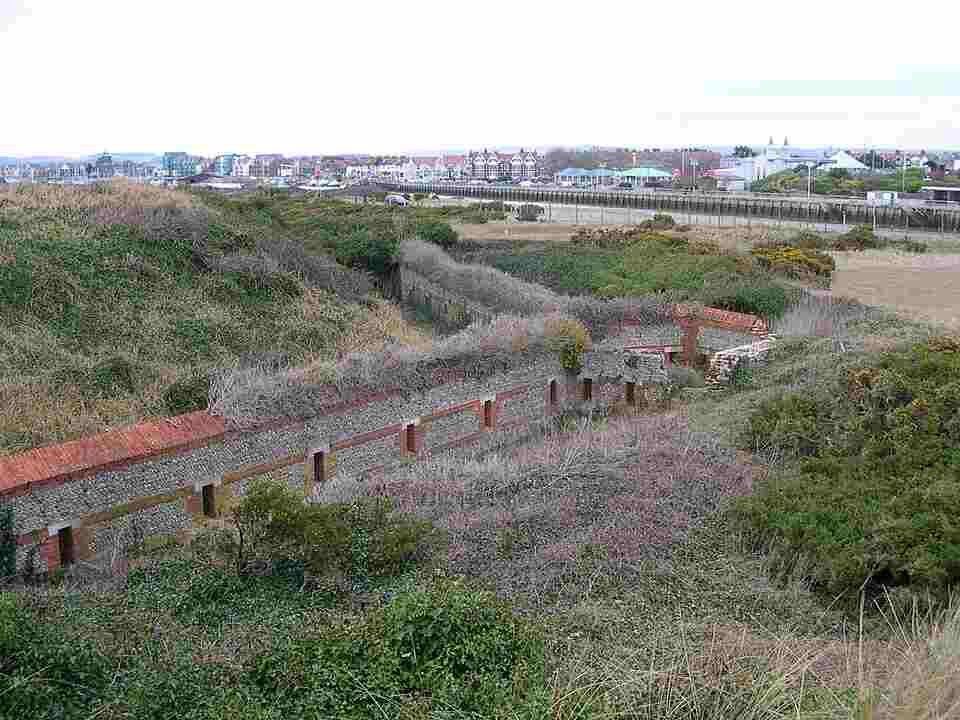
Littlehampton Fort is an innovative military pioneer, built to protect the River Arun entrance against potential French attack under Napoleon III. Completed in September 1854 at a cost of £7615, this lunette-shaped fort was the first to incorporate the revolutionary Carnot wall defensive feature, predating the famous Palmerston Forts by several years and serving as their experimental prototype.
The fort consisted of a gun platform from which cannon could sweep the harbour mouth, barracks behind, and surrounding defensive ditch and wall. The armaments included three 68-pounder and two 32-pounder cannons brought by sea from Woolwich Arsenal. The 1861 Census recorded a garrison of 70 men including gunner, surgeon, drummer, officers, NCOs and privates.
The strategic defensive importance stemmed from protecting Littlehampton and Shoreham ports. Military planners worried their capture would enable enemy use of quays for supplying and reinforcing troops landed to attack Portsmouth from the rear prior to marching on London. The west bank location commanded the river mouth with overlapping fields of fire.
However, rapid technological advancement rendered the fort obsolete within 20 years. The 1873 Committee on Coast Defences Report found Littlehampton Fort inadequate with only smooth bore guns, weak construction, open bastions, no casemates for guns, and no iron-cladding. Recommended upgrades were never implemented, guns were removed in 1891, and the fort was partially dismantled.
Construction was overseen by Captain Fenwick of the Royal Engineers, with main building work by Locke and Nesham, a large London firm who had constructed Wandsworth Prison and other public buildings. The glacis was built by local firm Robert Bushby. An additional barrack block was later built outside the fort to house extra troops.
Littlehampton Fort is now a Scheduled Monument in ruinous and overgrown state. The fenced site can be viewed from a wooden walkway across the sand dunes near Rope Walk. It remains a Building at Risk with Historic England and is subject to restoration project discussions, though public access is currently very limited due to its deteriorated condition and safety concerns.
Visitor Reviews from the Web
Positive reviews from those who locate the fort describe it as fascinating historical remnant demonstrating early Victorian coastal defense innovation. History enthusiasts appreciate seeing the Carnot wall prototype that influenced later Palmerston Forts.
The seaside sand dune location provides an atmospheric setting. Those interested in military architecture value seeing the lunette shape and defensive ditch remains. The viewing walkway allows safe observation of this Scheduled Monument.
Negative aspects dominate reviews due to the fort’s ruinous state and very limited accessibility. Many visitors struggle to locate it among sand dunes near the amusement park.
No visitor facilities, interpretation panels, or guided access exist. The overgrown condition disappoints those expecting well-preserved fortifications. Fencing prevents close examination of architectural features.
Some reviewers express frustration that such historically significant structure receives minimal conservation investment. The lack of signposting from Littlehampton town centre means most tourists remain unaware of its existence.
Frequently Asked Questions About Littlehampton Fort
What are Littlehampton Fort opening hours?
The fort is a fenced ruinous site viewable from a wooden walkway across sand dunes. No formal opening hours or visitor center. The viewing area is accessible during daylight hours year-round as it is public coastal land, though the fort interior is not accessible due to dangerous condition.
How much does it cost to visit Littlehampton Fort?
FREE viewing from the public walkway. The fort itself is fenced and inaccessible to the public for safety reasons. No admission charges for observing the ruins from the designated viewing area near Rope Walk and the sand dunes west of the River Arun.
Can you go inside Littlehampton Fort?
No, the interior is not accessible due to structural instability and safety concerns. The ruinous condition and lack of restoration mean only external viewing from the walkway is possible. The site is a Scheduled Monument and Building at Risk requiring significant conservation before public interior access becomes feasible.
Where is Littlehampton Fort located?
On the west bank of the River Arun near Rope Walk, amidst sand dunes west of Littlehampton town center. Access via the coastal path. The fort is approximately 317m southwest of the Windmill Theatre. Look for wooden walkways crossing the dunes in the area of Harbour Park amusement park.
Why was Littlehampton Fort built?
Built 1854 to protect Littlehampton and Shoreham harbour entrances from French naval attack under Napoleon III. Military planners feared enemy capture of these ports would enable supply lines for troops attacking Portsmouth from the rear before marching on London. The fort was an experimental design testing the Carnot wall concept.
What is special about Littlehampton Fort?
It was the first British fort to incorporate a Carnot wall and served as the prototype for later Palmerston Forts including Shoreham Fort. Despite its innovative military architecture and historical significance as a precursor to 72 subsequent fortifications, it has received minimal conservation and remains in ruinous state.
Nearby Defence Heritage Sites of Interest
| Site Name | Type | Distance (miles) |
|---|---|---|
| Arundel Castle | Medieval castle with military history | 4 |
| Amberley Museum Military Exhibit | Industrial heritage museum with military vehicles | 9 |
| Tangmere Military Aviation Museum | Military aviation museum | 11 |
| Shoreham Fort | Victorian coastal defence fort | 12 |
| Lewes Castle | Norman motte-and-bailey castle | 18 |
| Newhaven Fort | 19th/20th-century coastal fortification | 20 |
| Eastbourne Redoubt Fortress | Napoleonic-era coastal fortification and museum | 27 |
| Pevensey Castle | Roman/Saxon shore fort and medieval castle | 28 |
| Battle Abbey | Fortified abbey and 1066 battlefield site | 29 |
| Kent Battle of Britain Museum | Aviation and military museum | 30 |
Image credit: Charlesdrakew
Share
See on the Map
Contact Info
- West Beach, Rope Walk, Littlehampton, West Sussex BN17 5DL, England